How much does a Shopify loyalty program cost?
4 5月, 2026
What is a VIP loyalty program? And how it works
10 7月, 2026

Most post about VIP loyalty program examples rounds up the same five brands: Sephora, Nike, SHEIN, Starbucks, and Amazon Prime. They are useful as inspiration but not always useful as models. A Shopify merchant doing under $10M in annual revenue cannot realistically copy Sephora’s beauty event infrastructure or Nike’s app ecosystem. The budgets, teams, and customer touchpoints are completely different.
The better instructive examples come from brands that have delivered genuine tier differentiation with the resources available to a Shopify merchant: a loyalty app, an email platform, and a brand identity customers actually care about. This post covers five of them: specific program names, mechanics, and the one tactic from each worth borrowing.
What actually makes a VIP program work at Shopify scale
The best VIP loyalty program examples don’t use the usual Bronze/Silver/Gold structures that give slightly more points at each level and call it differentiation. Instead, each tier delivers a different type of value: entry tiers get transactional benefits (earn rates, birthday rewards); mid tiers get access benefits (early launches, exclusive sale windows); top tiers get experiential benefits (permanent discount rates, personal advisors, things no one else sees).
Every strong tiered program also has a name that is not just “Rewards Program.” Petal Perks, 333 VILLAGE, VitaCoins, Le Cercle, 4D Insider Club. These names create identity around the program rather than labeling a mechanic. Customers describe themselves as members of something.
All five brands run tiered loyalty programs without needing a big tech team. The tech stack is not the differentiator, but the design decisions.
1. threetimes with 333 VILLAGE

threetimes is a Korean women’s fashion brand on Shopify. Their loyalty program is called “333 VILLAGE.” Not “VIP Rewards.” A village.
Naming a program after a community rather than a mechanic does something a discount percentage cannot: it creates identity. Members of 333 VILLAGE think of themselves as people who belong to the threetimes brand world, not points collectors. For fashion brands where customers identify with the aesthetic and brand personality, that positioning creates retention that transactional rewards don’t reach.
The tactic worth borrowing: if your customers identify with your brand rather than just buy from it, name your program like a community. “[Brand] Village,” “[Brand] Club,” “[Brand] Collective” outperforms “Gold Member” for identity-led brands. The name signals what kind of loyalty the program creates, and that’s what VIP loyalty programs customers actually tell other people about.
2. FlowerChimp with Petal Perks

FlowerChimp is Southeast Asia’s largest online flower delivery brand, operating across Malaysia, Singapore, the Philippines, Hong Kong, and Indonesia on Shopify. Their loyalty program, “Petal Perks,” is a tiered structure where customers earn Petal Points on every purchase.
Flower delivery is occasion-driven: birthdays, anniversaries, Valentine’s Day, sympathy. A customer who sends flowers four times a year has a natural incentive to consolidate those purchases with one brand to protect tier status. Without a loyalty program, each occasion is a standalone decision. Petal Perks converts four separate buying decisions into a single ongoing relationship with a tier threshold worth maintaining.
The tactic worth borrowing: for brands where purchases are tied to recurring events, tier status creates consolidation incentive. “You’re one order away from Silver status before Mother’s Day” lands harder than a generic points reminder because the occasion is already coming. See other loyalty program examples in gifting categories for comparison.
3. Vitasave with Vitasave Rewards
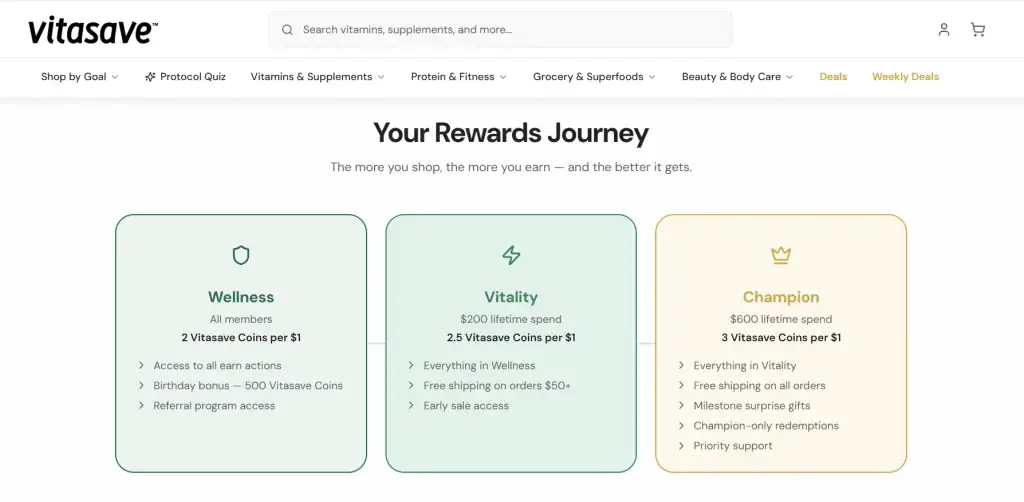
Vitasave is Canada’s largest online supplement and wellness store, carrying 3,000+ products. Their program, “Vitasave Rewards,” runs across three tiers: Wellness (all members), Vitality ($200 lifetime spend), and Champion ($600 lifetime spend).
Earn rates scale with tier: 2 VitaCoins per $1 at Wellness, 2.5 at Vitality, 3 at Champion. Vitality adds free shipping on orders over $50 and early sale access. Champion gets free shipping on all orders, milestone surprise gifts, and Champion-only redemptions.
The mechanic fits the category precisely. Supplement customers buy the same products every 30–90 days. A tiered earn rate creates switching cost without a discount: a Wellness member earns fewer VitaCoins per dollar than a Champion, so switching to a competitor means giving up an earn rate advantage that compounds over time. The program doesn’t change what the customer buys. It changes where.
The tactic worth borrowing: in consumable categories, make the switching cost concrete. “Your Gold earn rate is worth approximately $X per year based on your purchase history” makes the advantage visible and the tier worth protecting.
4. High Society
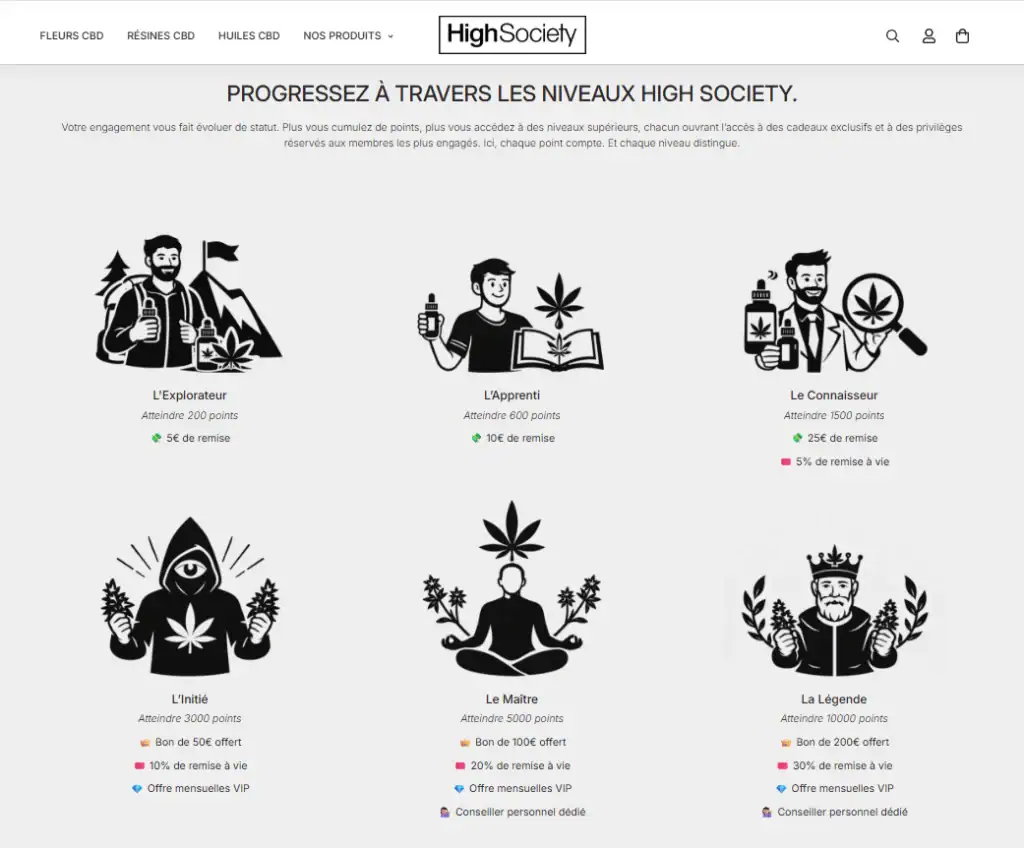
High Society is France’s number one online CBD shop, selling legal CBD flowers, oils, resins, and vapes on Shopify since 2018. In their VIP program, members progress through six tiers with names that mirror a journey of expertise: L’Explorateur, L’Apprenti, Le Connaisseur, L’Initié, Le Maître, and La Légende.
In this Shopify VIP tiers program, the early tiers give customers simple reasons to keep buying, while the higher tiers introduce benefits that feel harder to replace: lifetime discounts, monthly VIP offers, and eventually a dedicated personal advisor.
The most interesting mechanic is the permanent discount. It starts at Le Connaisseur and increases as customers move up the program. That lifetime discount creates a different kind of switching cost than a points balance. A customer can walk away from an accumulated point total without much friction. Walking away from a 20% permanent discount on every future order is a harder trade-off to make, and it gets harder with every repeat purchase.
The tactic worth borrowing: in consumable categories, a permanent status discount is more powerful than a redeemable points balance. The discount becomes part of the customer’s baseline expectation, and leaving means actively giving something up.
5. 4D Outfitters with 4D Insider Club

4D Outfitters is an Austrian boutique in Bregenz selling niche fragrances, fine jewelry, and lifestyle products. With a physical store and a Shopify online presence, the brand serves customers across the EU and brings more than 15 years of industry experience to a highly curated retail category.
Its loyalty program, the 4D Insider Club, is built around four spend-based tiers: Bronze from €0, Silber from €2,000 lifetime spend, Gold from €6,000, and Platinum from €15,000.
For 4D Outfitters, the strongest mechanic is the increasing sitewide discount. Silver members get 2% off, Gold members get 4%, and Platinum members get 6%. On paper, those percentages are modest. But for a boutique selling niche fragrances, fine jewelry, and premium lifestyle products, even a small permanent discount can feel meaningful because the average order value is likely higher than in everyday retail.
What makes this work is its simplicity. Customers do not need to calculate points or wait for a special redemption moment. Their status gives them a better price every time they shop. The more they buy from 4D Outfitters, the harder it becomes to go back to paying full price somewhere else.
The tactic worth borrowing: for premium retailers, a tiered sitewide discount does not need to be aggressive to be effective. When the products are high-value and the brand relationship matters, even a modest permanent discount can reinforce repeat purchase behavior.
What each example has in common
These programs work because the VIP status feels earned. Customers are not just collecting points in the background. They are moving into a closer relationship with the brand, where higher tiers unlock better access, better treatment, and a stronger sense of recognition. And that works so well when the product, service, and customer experience are already strong enough for people to want that status in the first place.
Each program matches its mechanic to the category:
- Vitasave uses tiered earn rates because switching cost compounds over repeat purchases.
- 4D Outfitters uses tiered sitewide discounts because repeat purchase in premium retail often depends on trust, familiarity, and a reason to come back.
- FlowerChimp uses tier consolidation because gifting purchases are predictable.
- threetimes333 uses community naming because customers identify with the brand world.
- High Society uses a lifetime discount because a permanent rate is harder to abandon than a points balance.
The strongest programs here also go beyond points differentiation per tier. Each delivers transactional, access, and experiential benefits at different stages of the member journey.
FAQ
What is a real-world example of a VIP loyalty program for a Shopify brand?
FlowerChimp’s “Petal Perks” and threetimes333’s “333 VILLAGE” are both effective VIP programs built by Shopify brands below Sephora’s scale. Petal Perks uses occasion-driven purchasing to create tier consolidation. As a result, each predictable buying event becomes a reason not to switch brands. 333 VILLAGE uses community identity to make the program feel like membership. Both run on Shopify loyalty app (BON Loyalty).
What VIP program perks actually drive repeat purchases?
Early access to product launches, earn rate multipliers by tier, and exclusive branded merchandise consistently outperform flat discount percentages for driving repeat purchase behavior. The programs with the highest repeat purchase rates share one trait: perks that increase meaningfully with tier status, not just a slightly larger coupon at each level.
Do VIP programs work for Shopify stores in competitive categories?
Yes, but the right mechanic depends on the category. In consumable categories, tiered earn rates or lifetime discounts create switching cost because customers repurchase regularly and any status benefit compounds over time. In fashion and lifestyle, identity and access perks outperform discounts. In occasion-driven categories, tier status creates consolidation. In discovery-driven categories like fragrance, product samples generate future purchase intent more efficiently than discounts.
How many tiers should a Shopify VIP loyalty program have?
The programs in this post range from three tiers (Vitasave’s Wellness/Vitality/Champion) to six (High Society’s Le Cercle). Three tiers is the practical minimum for meaningful differentiation. More than four works well in consumable or repeat-purchase categories where customers have a natural progression arc. For fashion and lifestyle brands with lower purchase frequency, three tiers usually delivers the same retention effect with less program complexity to manage.
Final thoughts: Build something worth belonging to
The programs worth copying aren’t the ones with the biggest budgets. They’re the ones where someone made intentional design decisions: named the program something that creates identity, matched the reward mechanic to the category, delivered a different type of value at each tier. The common thread across all five brands here isn’t the mechanic. It’s the intention behind it.
Author